Calamity Jane's Solo-group navigation crisis
Happiness for BeginnersThe Calamity Jane group’s navigation crisis begins not with a dramatic emergency but with a shortcut: while Helen and Jake enjoy talking together again, they stop paying close attention to their route, and Mason leads the group away from the trail. The detour costs hours, leaves the four hikers bushwhacking through rough ground, and makes finding water an immediate concern. Getting back to the marked route brings relief, but the day ends with another obstacle: a steep ravine and a rickety rope bridge above the stream they need.
The Shortcut and Its Discovery
Helen had been avoiding Jake since the evacuation, and the two fall easily into joking conversation when they spend time together again. Their renewed rapport has a practical consequence: they pay so little attention to the route that they fail to notice the mistake for much of the morning. By around noon, the group is no longer following the planned course.
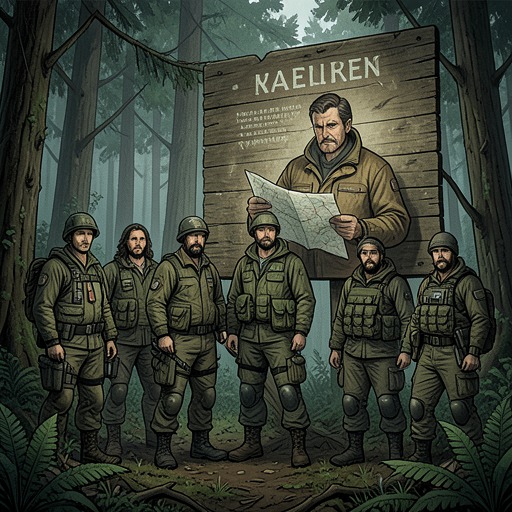
The group was meant to contour around a hill. Instead, Mason has taken them over it, treating the detour as a shortcut. When the hikers catch up with him and Dosie, the trail appears to disappear beneath pine trees, where sandy ground and sparse undergrowth make a faint track difficult to distinguish. Helen recognizes that the route itself is wrong: they should not be going over a hill. Mason admits that they have been off course for two or perhaps three hours.
The map makes the choice legible. The intended trail bends in an oxbow around the half-circle edge of the hill, and Mason has reasoned that crossing directly will save the distance. Helen objects that the shortcut has no trail; Mason maintains that he followed one. The disagreement is sharpened by a basic navigational error: when Helen takes the map, she sees that Mason has been holding it upside down. The scene turns a seemingly sensible attempt to save time into evidence that the group has lost both the route and confidence in its reading of it.
Bushwhacking Back to the Trail
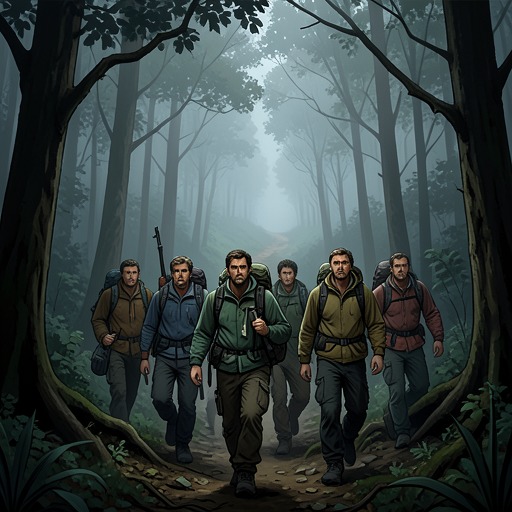
Rather than continue the shortcut, the hikers begin working their way back down the hill. Helen uses her compass to hold a straight line. That is easier beneath the trees, but becomes harder when the trees thin and the underbrush thickens. After an hour, the group is bushwhacking; their legs are scratched and bleeding, and repeated stumbles add to the strain. Jake falls most often and also scratches his arms and face.
Animal trails offer tempting paths through the brush, but the group resists following them because doing so could take them off course again. That shared decision matters: although the mistake began with a shortcut and the four have to force their way through difficult terrain, adversity keeps them close together. They continue as a unified group rather than splintering into separate attempts to find an easier way.
The possibility of going without water sharpens the stakes. Dosie asks what will happen if they cannot find any that night, and Helen answers that they will find it the next day. When Dosie raises the danger associated with these trips, Helen and Jake respond together that the trips are under new management. Their synchronized answer briefly restores humor, but it does not erase the physical cost or uncertainty of the detour.
Finding the Route—and the Stream
Four hours pass before the group reaches the trail again. The sight of it brings immediate relief: exhausted and bleeding, all four hikers hug. Their recovery is incomplete, however. They have backtracked and rejoined the trail at a point they have already passed. The stream crossing is still about a mile away, and it is already five in the afternoon.
The final mile takes another hour. At the crossing, the map’s indication that a stream meets the trail proves true, but it has not conveyed the difficulty of reaching the water. The trail crosses a ravine, with the creek bed roughly a hundred feet below, using a rickety rope bridge. The bridge makes the stream crossing feel perilous even before the hikers know whether water is actually present.
Helen worries that the creek bed might be dry after all. Looking down, the group sees that it is wet, and her relief closes the immediate search for water. The crisis therefore ends in partial recovery rather than an easy return to safety: the group has found the trail and water, but only after hours of wrong-way hiking, a punishing return through brush, and a hazardous crossing.
Significance Within the Exercise
The episode exposes the cost of treating navigation rules as optional. Mason’s shortcut is meant to reduce distance, yet the upside-down map, the hours spent off route, and the difficult return make it a source of delay and injury instead. The hikers’ restraint in refusing animal trails and their decision to stay together provide a counterpoint: once the mistake is recognized, they work to restore a shared course rather than compound it with more improvisation.
The crisis also brings Helen and Jake back into easy companionship after her deliberate avoidance of him since the evacuation. Their joking precedes the lapse in attention, but their cooperation continues once the consequences become serious: they share the response to Dosie’s question about the trip’s dangers and endure the return hike as part of the same group. Relief at seeing the trail and, later, water gives the episode its two turns, while the rope bridge leaves the final success marked by the landscape’s remaining hazards.